Common Mistakes in Electronic Tax Systems
Problems in e-invoicing, e-ledger and bank integration projects rarely come from the technology. The seven mistakes we see most often in the field, with a practical remedy for each.
1. Starting before master data is fixed
Customer records with missing or wrong tax IDs, suppliers with an empty tax office field, materials with inconsistent units and VAT codes. The electronic document carries this data as it is and gets rejected. Remedy: a master data audit before go-live; automatic and regular e-invoice taxpayer lookups.
2. Leaving rejection and cancellation flows for later
The sending flow is built, but nobody thinks about what happens on rejection. The rejected document stays open in SAP and accounting drifts apart from e-document status. Remedy: managing rejection, cancellation and objection scenarios by status inside SAP; seeing document status on one screen.
3. Add-ons buried in the SAP core
ABAP code updated at every regulatory change, the add-on retested at every SAP upgrade. Over time the system slows down and upgrades are postponed. Remedy: the Clean Core approach; keeping regulatory logic outside SAP in a layer such as SAP BTP, so the integration stays the same from SAP R/3 to Public Cloud.
4. Underestimating timestamp and deadline rules
A late e-archive report, e-ledger certificates left to the last day, a waybill issued after dispatch. Each is a penalty risk. Remedy: deadlines defined in the system as warnings and blocks; the calendar living in the product, not in one person's memory.
5. Matching bank movements by hand
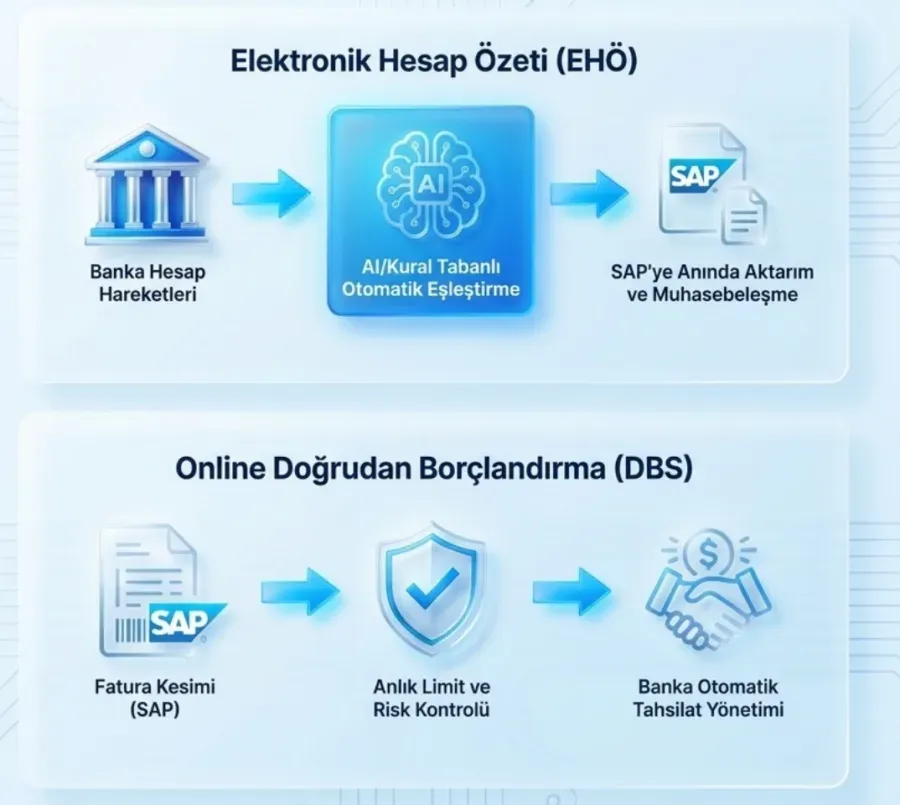
Statement lines are retrieved automatically but collections are cleared manually; the team reads statements every morning. Remedy: automatic matching that extracts invoice and customer from the description text; unmatched items queued with their reason. AI-assisted matching is the investment that saves the most time at this step.
6. Building the archive for today, not for the legal retention period
Documents sit at the integrator or in a folder; ten years later, in an audit, the document and signature cannot be verified. Remedy: an archive that stays accessible and verifiable through the legal retention period, and documents that can be migrated when the integrator changes.
7. Opening a separate project for every country
An add-on for Germany, another provider for Spain, a third system for Türkiye. The result: three contracts, three maintenance cycles, inconsistent reporting. Remedy: one integration layer that manages country rules; the document produced in SAP with country regulation applied in the layer.
The common thread
All seven mistakes share one root: e-transformation is not a sending task but a process-management task. Seeing the whole chain in one place, from document creation to archiving and from bank movement to reconciliation, prevents most errors before they happen. TecT products present this chain in one cockpit inside SAP and on mobile through TecT App.