Artificial Intelligence in Tax Technology
AI is no longer a showcase feature in tax and e-transformation; it is a layer that works inside daily operations, from document matching to anomaly detection. Where does it create real value on the SAP side, and where is care needed?
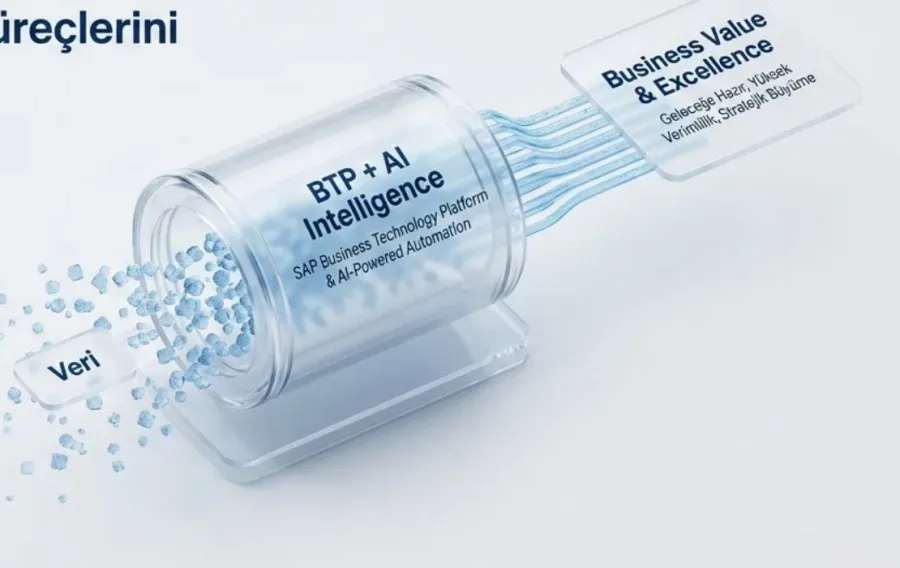
From rule-based automation to learning systems
Processes such as e-invoicing, e-ledger and bank integration have been automated with rules for years: the document must be in this format, this field must be filled, it must be sent before this date. Rules work very well in defined scenarios; the trouble begins with the undefined ones. A bank movement with a non-standard description, a product name written differently by the supplier, the same invoice arriving twice. AI fills exactly this gap: it learns from examples and decides on similarity and probability.
Concrete use cases on the SAP side
- Three-way matching on incoming invoices. Purchase order, delivery note and invoice are matched line by line; amount and quantity deviations are flagged against tolerance thresholds. Unmatched lines reach the user with a reason, not in an anonymous queue.
- Posting bank statement lines. Customer, invoice number and payment type are extracted from free-text statement descriptions; a clearing proposal is generated automatically. Match rates that stall around 60-70 percent with rules rise markedly with learning models.
- Duplicate invoice and anomaly detection. Two documents from the same supplier with similar amounts and close dates; a VAT rate outside the usual range; an IBAN seen for the first time. These are hard to write as rules but easy to detect as patterns.
- Natural-language queries. "Which dealers hit their direct-debit limit this month?" needs no report design; the answer comes straight from product data.
What to watch out for
Tax processes do not tolerate errors, so the line between an AI suggestion and human approval must be clear. A well-designed system follows three principles. First, the model works only on the company's own product data; it never touches documents sent to the tax authority or the regulatory side. Second, every suggestion is shown with its reasoning; the user sees why a match is proposed. Third, an audit trail is kept; who approved or rejected which suggestion, and when, can always be answered.
Where to start
The fastest return comes from high-volume processes with measurable error costs: posting bank movements and matching incoming invoices lead the list. In TecT products these capabilities are not a separate tool; they work inside the e-Invoice, e-Banking and e-Waybill modules, need no additional development on the SAP side and are also available on mobile through TecT App.